Kitchen & Cookware
PFAS-free cookware, with the terminology sorted out first
PTFE is a PFAS. PFOA-free is not PFAS-free. Nobody certifies the phrase. Here is what you can actually buy.
Last reviewed October 13, 2026 — Selena H.

Three terms get used interchangeably in this category and they mean different things. PFAS is a very large family of per- and polyfluoroalkyl substances, which EPA describes as breaking down very slowly and building up in people, animals and the environment over time. PFOA is one specific PFAS that has been out of US non-stick manufacture for well over a decade. PTFE is the fluoropolymer that makes a pan non-stick — and PTFE is itself a PFAS.
That last fact is why "PFOA-free" appears on pans that are PTFE-coated and why the claim is simultaneously true and useless to someone trying to avoid fluoropolymers. "PFAS-free" is not a regulated term and nobody certifies it, so the only reliable way to avoid this chemistry in cookware is to buy a material that never involved it. All five picks below are in that category.
Quick picks
| # | Product | Best for | Material | Price |
|---|---|---|---|---|
| 1 | Made In Stainless Clad SetUncoated stainless. No fluoropolymer because there is no coating at all. | The default answer | 5-ply stainless clad: 304 stainless cooking surface | |
| 2 |  Lodge Cast Iron Skillet (10.25 in)Iron and oil. The lowest-cost fluoropolymer-free pan you can buy. | Cheapest route out | Bare cast iron | |
| 3 | 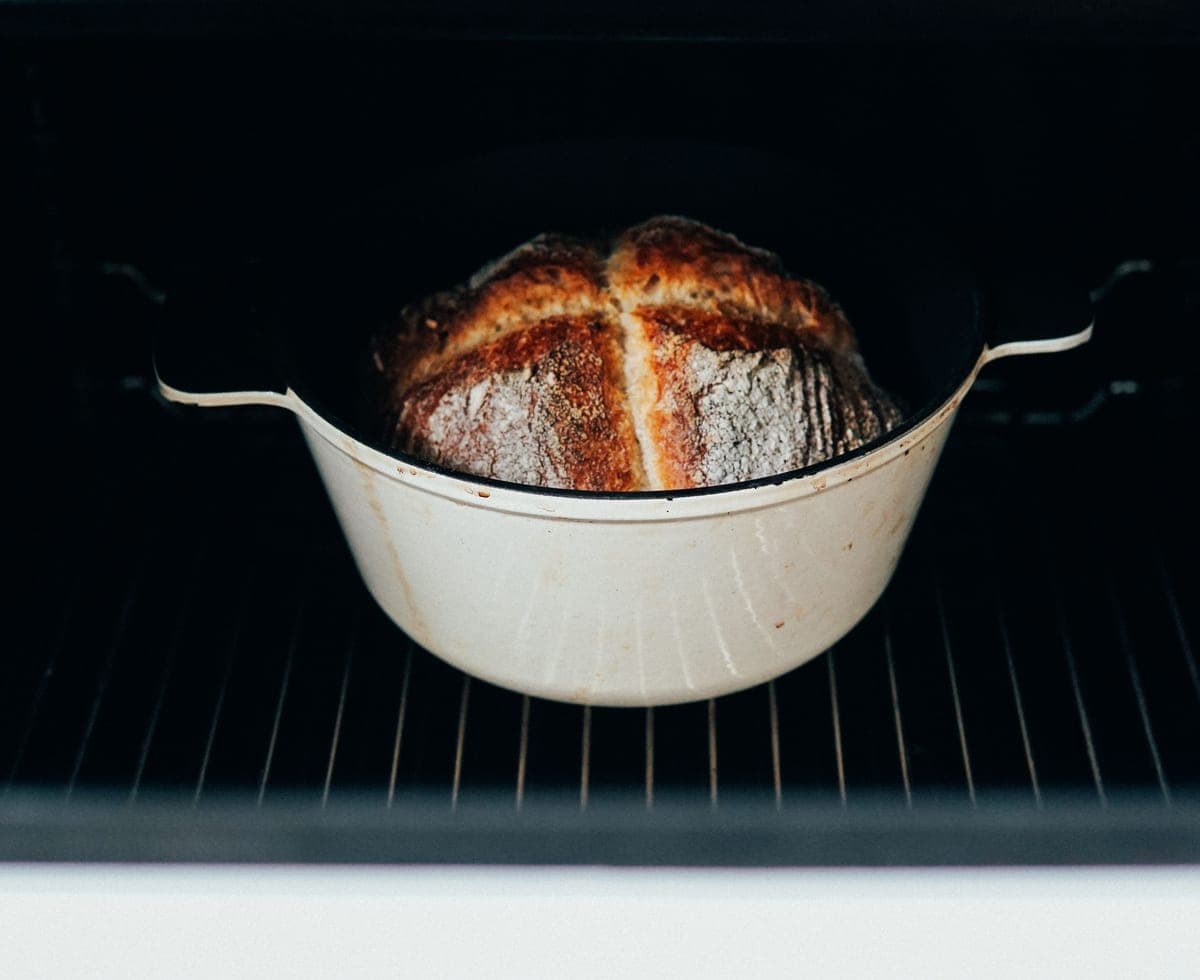 Le Creuset Enameled Dutch OvenVitreous enamel is fired glass. Inert, and nothing to do with fluoropolymers. | Acidic cooking with no coating | Cast iron core with a fired vitreous enamel interior and exterior | |
| 4 |  Xtrema Versa SkilletOne ceramic material through the body. No coating, no metal, no fluoropolymer. | No coating of any kind | 100% ceramic through-body (no metal core | |
| 5 |  Caraway Cookware SetA sol-gel mineral coating with no PTFE, and a replacement cycle to plan for. | Non-stick without a fluoropolymer | Aluminum body |
Tap a row to jump to that write-up. Prices are not shown on this site because they change — the button sends you to the live Amazon listing.
The three terms, separated
| Term | What it is | What a label using it tells you |
|---|---|---|
| PFAS | A large family of per- and polyfluoroalkyl substances. EPA notes many break down very slowly and accumulate | Nothing verifiable — the phrase "PFAS-free" is unregulated and uncertified |
| PFOA | One specific PFAS, out of US non-stick manufacture for over a decade | Very little. Almost everything on sale is PFOA-free |
| PTFE | The fluoropolymer that makes a pan non-stick. It is itself a PFAS | This is the one that matters. PTFE-free is the claim to look for |
| GenX / PFOS / others | Other members of the family, some used as processing aids | Rarely mentioned on cookware packaging at all |
What regulators have actually done
The clearest regulatory action in this area is in food packaging rather than cookware. FDA announced in February 2024 that PFAS used as grease-proofing agents on paper and paperboard food packaging were no longer being sold into the US market, completing a phase-out it began securing commitments for in 2020 — and in January 2025 determined that 35 related food contact notifications were no longer effective because those uses had been abandoned. FDA described this as eliminating the primary source of dietary exposure from authorized food contact uses.
Cookware coatings were not the subject of that action. PTFE-coated pans remain legal and widely sold, which is why the decision about them is yours rather than a regulator's, and why the honest framing on this page is a materials choice rather than a safety warning.
How to verify a PFAS-free claim yourself
- Look for the word PTFE or Teflon, not PFOA. A pan that says only "PFOA-free" has told you nothing about its coating.
- Look for a positive coating description. "Sol-gel ceramic" or "mineral coating" is a real answer. "Advanced non-stick technology" is not.
- Prefer no coating. An uncoated material cannot contain a coating-based PFAS, and this is the only fully verifiable position available.
- Treat third-party testing claims as claims unless the report is published. "Tested for 600 forever chemicals" with no report is the brand's statement.
- Ignore the phrase PFAS-free on its own. It is unregulated, uncertified and legally meaningless on cookware.
The picks in full
1. Best for The default answer
Made In Stainless Clad Set
Uncoated stainless. No fluoropolymer because there is no coating at all.
- Made of
- 5-ply stainless clad: 304 stainless cooking surface, aluminum core layers
- Certified to
- Manufacturer claimManufacturer claim; no third-party certification published.
- Construction
- 5-ply clad
- Cooking surface
- 304 stainless steel
- Coating
- None
The simplest route to a fluoropolymer-free kitchen is to buy cookware with no coating in it. Uncoated 5-ply clad stainless has a 304 stainless cooking surface and nothing applied over it, so the question does not arise. It is also the material with the longest service life of anything on this page.
What you give up
Technique for eggs and fish, weight, and scrubbing instead of wiping.
Who it's for
Anyone who wants the question closed permanently rather than managed.
Who should skip it
Cooks who need non-stick release with no fat and no preheat.
2. Best for Cheapest route out
Lodge Cast Iron Skillet (10.25 in)
Iron and oil. The lowest-cost fluoropolymer-free pan you can buy.
- Made of
- Bare cast iron, factory-seasoned with vegetable oil
- Certified to
- Manufacturer claimManufacturer claim; no third-party certification published.
- Coating
- None. Polymerized oil seasoning only
- Oven safe
- Manufacturer states oven, grill and campfire safe
- Induction
- Yes
Nothing about a seasoned cast iron pan involves synthetic coating chemistry: the release surface is vegetable oil polymerized onto iron, which you can strip and rebuild forever. It is the cheapest pan in this list by a wide margin, which means the cost of leaving the coated category can be under thirty dollars.
What you give up
Weight, seasoning maintenance, and no long acidic cooking.
Who it's for
Anyone leaving coated cookware on a budget.
Who should skip it
Iron-overload conditions, and anyone unable to lift a heavy pan.
3. Best for Acidic cooking with no coating
Le Creuset Enameled Dutch Oven
Vitreous enamel is fired glass. Inert, and nothing to do with fluoropolymers.
- Made of
- Cast iron core with a fired vitreous enamel interior and exterior
- Certified to
- Manufacturer claimManufacturer claim; no third-party certification published.
- Interior
- Sand-colored vitreous enamel
- Seasoning needed
- No
- Induction
- Yes
Enamel is glass fused to iron, which is about as far from fluoropolymer chemistry as cookware gets. It is also the right surface for the one job bare iron cannot do and stainless does least well — long cooks with tomato, wine or vinegar.
What you give up
Price, weight and chip risk. A chipped interior means the end of its useful life.
Who it's for
Braises and stews, with no coating anywhere in the pot.
Who should skip it
High-heat dry searing, and small kitchens with limited storage.
4. Best for No coating of any kind
Xtrema Versa Skillet
One ceramic material through the body. No coating, no metal, no fluoropolymer.
- Made of
- 100% ceramic through-body (no metal core, no surface coating)
- Certified to
- Manufacturer claimManufacturer claim; no third-party certification published.
- Construction
- Solid ceramic, not a coated metal pan
- Oven and broiler
- Manufacturer states oven, broiler and grill safe
- Induction
- No
This is the most literal answer to the question. There is no coating to contain PTFE, and no metal either, because the pan is solid ceramic through its whole thickness. If you want to eliminate the category of "applied surface" entirely, this is the product that does it.
What you give up
Slow, fragile, not induction compatible, and not actually non-stick.
Who it's for
Shoppers who want the fewest possible unknowns in a pan.
Who should skip it
Induction cooktops and fast cooking.
5. Best for Non-stick without a fluoropolymer
Caraway Cookware Set
A sol-gel mineral coating with no PTFE, and a replacement cycle to plan for.
- Made of
- Aluminum body, sol-gel mineral ceramic coating, stainless steel handles and base plate
- Certified to
- Manufacturer claimManufacturer claim; no third-party certification published.
- Oven safe
- Manufacturer states 550F
- Coating type
- Ceramic (sol-gel), no PTFE
- Induction
- Yes, stainless base plate
If non-stick release is non-negotiable, a sol-gel ceramic coating gives you it without a fluoropolymer. Caraway publishes the stack and states third-party testing for over 600 forever chemicals, which we report as the brand's own claim rather than a published lab result. For a household that will not cook on stainless, this is the honest option.
What you give up
The coating wears out in one to three years, and no coated pan avoids that. A testing claim is also not the same as a certificate you can look up.
Who it's for
Egg-heavy cooking in a household that wants no PTFE.
Who should skip it
Anyone who wants a permanent purchase or a verifiable third-party certification.
How we chose, and what we did not do
Every product on this page was checked against its published material composition and its third-party certifications, with each claim labeled as certified, manufacturer-stated or independently tested by a named party. We do not run a lab and we do not claim to have used these products — the full method is here.
Questions people actually ask
Is PTFE a PFAS?
Yes. PTFE (polytetrafluoroethylene) is a fluoropolymer within the PFAS family, which is why a PTFE-coated pan cannot honestly be called PFAS-free even when it is genuinely PFOA-free.
Does PFOA-free mean a pan is safe?
It means one specific compound is absent, and that has been standard in US non-stick manufacture for over a decade. It says nothing about whether the pan is coated with PTFE.
Is there a certification for PFAS-free cookware?
No. The term is unregulated and no body certifies it for cookware, which is why buying an uncoated material is the only fully verifiable way to avoid fluoropolymer chemistry in a pan.
Did the FDA ban PFAS in cookware?
No. FDA's completed action concerned PFAS grease-proofing agents on paper and paperboard food packaging, not cookware coatings. PTFE-coated pans remain legal and widely sold.
Sources
- US EPA — Our Current Understanding of the Human Health and Environmental Risks of PFAS — Regulator overview of PFAS persistence and health endpoints
- US FDA — PFAS used as grease-proofing agents in food packaging are no longer sold in the US — February 2024 update confirming the completed phase-out
- US FDA — 35 food contact notifications related to PFAS are no longer effective
- US FDA — Authorized Uses of PFAS in Food Contact Applications
- Caraway Home (manufacturer)
Read next
Kitchen & Cookware
What PFAS actually means in cookware
PFAS, PFOA and PTFE separated with sources, plus what the labels can and cannot promise.

Kitchen & Cookware
Is Teflon safe to cook with?
What the evidence actually says about PTFE: normal use, overheating, scratched pans, and birds.
Kitchen & Cookware
Best non-toxic cookware of 2026 — certification-checked picks
The flagship roundup: six cookware options sorted by material, each with its published composition and certification position.
Kitchen & Cookware
The safest cookware materials, in one table
The flagship comparison table: every cookware material on PFAS status, heat limit, leaching concern and lifespan.
Written by Selena H., owner of Glass & Cotton.