Cleaning & Laundry
Best non-toxic all-purpose cleaners
This is the one product you deliberately turn into an airborne mist in a small room. Worth getting right, and easy to.
Last reviewed October 13, 2026 — Selena H.
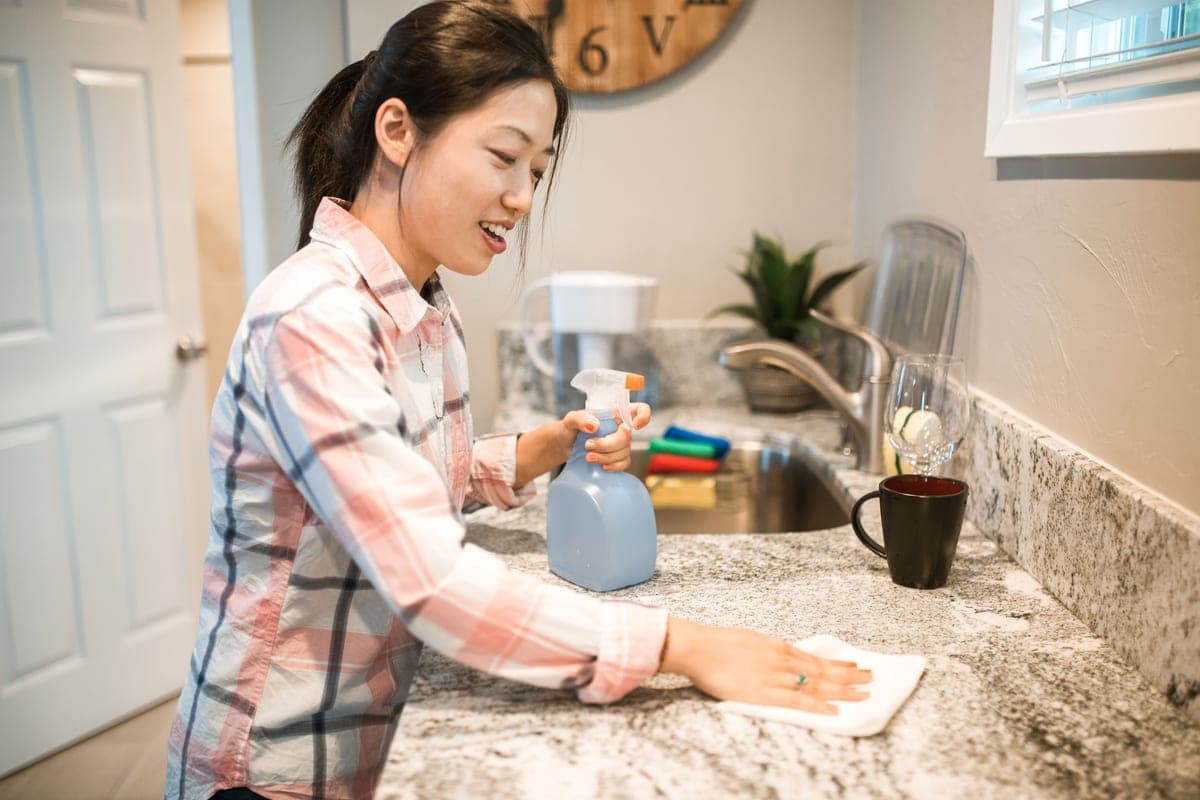
Cleaning products are the only category in the house you inhale on purpose. A spray cleaner is aerosolized in a bathroom with the door shut, repeatedly, and the people who get hurt by cleaning chemistry are overwhelmingly those exposed to it most often.
Two marks genuinely help here. EPA Safer Choice reviews all chemical ingredients regardless of their percentage in the product, requires each to meet criteria for human health and the environment, and — unusually — also requires the product to clean comparably to a conventional one. MADE SAFE screens the full formula against a list of substances known or suspected to harm health. Everything else on a cleaning label is unregulated language.
Quick picks
| # | Product | Best for | Material | Price |
|---|---|---|---|---|
| 1 | Branch Basics ConcentrateMADE SAFE certified concentrate, diluted at home into several different cleaners. | One certified bottle | Plant- and mineral-derived surfactant concentrate | |
| 2 | Attitude All-Purpose CleanerPlant- and mineral-sourced surfactants, fully listed, scented and unscented versions. | Ready to use | Plant- and mineral-sourced surfactants | |
| 3 | Dr. Bronner's Pure-Castile Liquid SoapSaponified organic oils, no synthetic detergent, extremely high dilution. | Cheapest per use | Saponified organic oils | |
| 4 |  Distilled White Vinegar (cleaning strength)Acetic acid, one ingredient, pennies per use. Not a disinfectant. | Scale and glass | Diluted acetic acid |
Tap a row to jump to that write-up. Prices are not shown on this site because they change — the button sends you to the live Amazon listing.
How we chose these
We required a full ingredient list or a named third-party certification, and ideally both. Products whose formula is withheld as a trade secret did not make the page — that is the brand's prerogative and it is also our answer.
We then looked for products that genuinely cover a job rather than a mood: a concentrate that replaces several bottles, a ready-to-use spray with a readable label, and the two commodity products that do a real share of household cleaning for almost nothing.
What the two marks actually cover
Neither mark means a product disinfects. A disinfection claim requires EPA registration as a pesticide, which is a separate process with its own number on the label.
| EPA Safer Choice | MADE SAFE | |
|---|---|---|
| Who runs it | US Environmental Protection Agency | A non-profit certification program |
| Ingredient review | All ingredients regardless of percentage | Full formula against a health-hazard list |
| Performance required | Yes — must clean comparably to conventional | No |
| Packaging reviewed | Yes, against the Safer Choice Standard | Not a core criterion |
| Categories | Mostly cleaning and institutional | Cleaning, personal care, bedding, baby, home |
| Means it disinfects | No | No |
What to look for on the label
- A full ingredient list with functions. The best brands say what each component does.
- "Fragrance" as a single word. Under FDA's cosmetic labeling rules an entire fragrance mixture can be declared as one word because formulas are treated as trade secrets, and household products follow the convention. Unscented removes the question.
- An EPA registration number — present only on registered disinfectants. Information, not a verdict.
- A dwell time. Only disinfectants have one. If the label specifies minutes, use them or use a different product.
- Safer Choice or MADE SAFE, the two marks here that review the formula rather than the packaging.
What we ruled out
Cleaners whose ingredients are withheld, which remains common in this category. Products relying on "plant-based" or "non-toxic" with no disclosure behind it — neither term has a regulatory definition for cleaning products. Quat-based disinfectant sprays used as everyday cleaners, since the occupational evidence links quats to rhinitis and asthma and most household cleaning does not need a disinfectant at all. And antibacterial hand soaps, which are a different product class with their own regulatory history.
The picks in full
1. Best for One certified bottle
Branch Basics Concentrate
MADE SAFE certified concentrate, diluted at home into several different cleaners.
- Made of
- Plant- and mineral-derived surfactant concentrate, diluted at home
- Certified to
- Certified: MADE SAFEThird-party certified to MADE SAFE.
- Certification
- MADE SAFE certified concentrate
- Format
- One concentrate, several dilutions
- Fragrance
- None
One certified concentrate replaces the four single-purpose sprays under most sinks, which reduces both what you inhale and what you store. MADE SAFE lists the Concentrate among its certified products alongside the brand's Oxygen Boost, hand soap and candle, and the formula is fragrance-free so there is no undisclosed scent mixture.
What you give up
You mix it yourself, which is a habit some households will not keep up, and the up-front price looks high until you divide it by the dilutions. It is not a disinfectant and makes no kill claim.
Who it's for
Everyday cleaning across mixed surfaces, in a household willing to dilute.
Who should skip it
Anyone who wants a ready-to-use spray, or who needs a registered disinfectant.
2. Best for Ready to use
Attitude All-Purpose Cleaner
Plant- and mineral-sourced surfactants, fully listed, scented and unscented versions.
- Made of
- Plant- and mineral-sourced surfactants, water
- Certified to
- Manufacturer claimManufacturer claim; no third-party certification published.
- Ingredients
- Fully listed on pack
- Fragrance
- Scented and unscented versions
- Note
- Check the specific SKU's certification
The practical pick for households that will not mix a concentrate. Ingredients are listed in full on the pack, which is the baseline requirement in a category where disclosure is voluntary, and an unscented version removes the fragrance question entirely.
What you give up
Certification varies by SKU, so check the specific product rather than relying on the brand. Scented versions carry a fragrance mixture that is not itemized.
Who it's for
Grab-and-spray convenience with a readable label.
Who should skip it
Anyone who wants a single certified product covering every job.
3. Best for Cheapest per use
Dr. Bronner's Pure-Castile Liquid Soap
Saponified organic oils, no synthetic detergent, extremely high dilution.
- Made of
- Saponified organic oils, water, no synthetic detergent
- Certified to
- Manufacturer claimManufacturer claim; no third-party certification published.
- Base
- Saponified oils
- Dilution
- Very high. One bottle lasts
- Do not mix
- With vinegar or acids, it curdles
Castile soap is close to the simplest cleaning product available: saponified oils and water, no synthetic surfactant, and a dilution ratio so high that one bottle lasts an extraordinarily long time. For floors, surfaces and general washing it is effective and cheap.
What you give up
Do not mix it with vinegar or any acid — it curdles into a white film, which is the single most common castile-soap mistake. It also leaves a film on glass, so it is the wrong product for windows.
Who it's for
Floors, surfaces and general cleaning at minimal cost.
Who should skip it
Glass, and anyone who wants to combine it with an acidic cleaner.
4. Best for Scale and glass
Distilled White Vinegar (cleaning strength)
Acetic acid, one ingredient, pennies per use. Not a disinfectant.
- Made of
- Diluted acetic acid, typically 5 to 6%
- Certified to
- Manufacturer claimManufacturer claim; no third-party certification published.
- Active
- Acetic acid
- Disinfectant
- No. It is a cleaner, not a registered disinfectant
- Avoid on
- Stone, grout, cast iron
For limescale, kettles, showerheads and glass, vinegar is not a compromise — it is the correct product and the cheapest one. Cleaning-strength vinegar at around 6% acidity works faster than kitchen vinegar on scale.
What you give up
No disinfection claim at all, and it etches natural stone, damages unsealed grout, strips cast iron seasoning and cuts waxed wood finishes.
Who it's for
Descaling and glass.
Who should skip it
Stone surfaces, disinfecting, and heavy grease.
How we chose, and what we did not do
Every product on this page was checked against its published material composition and its third-party certifications, with each claim labeled as certified, manufacturer-stated or independently tested by a named party. We do not run a lab and we do not claim to have used these products — the full method is here.
Questions people actually ask
Do non-toxic cleaners actually clean as well?
Products carrying EPA Safer Choice certification must perform comparably to conventional products — performance is part of the standard, not an afterthought. A MADE SAFE certified product has been screened for hazards but makes no performance promise, so pair that mark with reviews or your own test.
What does fragrance hide on a cleaning label?
A mixture that can run to dozens of components. FDA's cosmetic rules let the whole blend be declared as one word because fragrance formulas are treated as trade secrets, and household products follow the same convention.
Is one concentrate really enough for the whole house?
For cleaning, largely yes — different dilutions of a single surfactant concentrate cover surfaces, floors, glass and bathrooms. For disinfecting you need a separate registered product, and for limescale you want vinegar.
Can I mix castile soap and vinegar?
No. The acid breaks the saponified oils and you get a curdled white film that is worse than either ingredient alone. Use them in sequence if you use both.
Does a Safer Choice label mean a product disinfects?
No. Disinfection claims require EPA registration as a pesticide, which is a separate process. Safer Choice is about ingredient safety and cleaning performance.
Sources
- US EPA — Learn About the Safer Choice Label — Every ingredient reviewed regardless of its percentage, plus a performance standard
- MADE SAFE — Branch Basics certified products
- MADE SAFE — certification
- US FDA — Fragrances in Cosmetics — The rule that lets an entire fragrance mixture be listed as one word
- Safer Disinfectants — quaternary ammonium compounds (quats) in disinfectants — Occupational asthma and respiratory evidence for quats
Read next
Cleaning & Laundry
Vinegar vs commercial cleaners
What vinegar actually cleans, what it cannot disinfect, and where a formulated product earns its price.
Cleaning & Laundry
How to read a cleaning product label
Six label checks for cleaning products, including the only number on the bottle that is regulated.
Cleaning & Laundry
Best non-toxic disinfectants
EPA-registered disinfectants that avoid quats, plus why dwell time is the whole product.
Cleaning & Laundry
What MADE SAFE certification covers
MADE SAFE explained: full-formula hazard screening, the categories it spans, and what it deliberately ignores.
Written by Selena H., owner of Glass & Cotton.