Kitchen & Cookware
PTFE, PFA and FEP: what the coating acronyms on a pan mean
Four letters apart, and they are not interchangeable. One is the coating, two are its neighbors in the same can, and one was phased out of US production in 2015.
Last reviewed October 27, 2026 — Selena H.
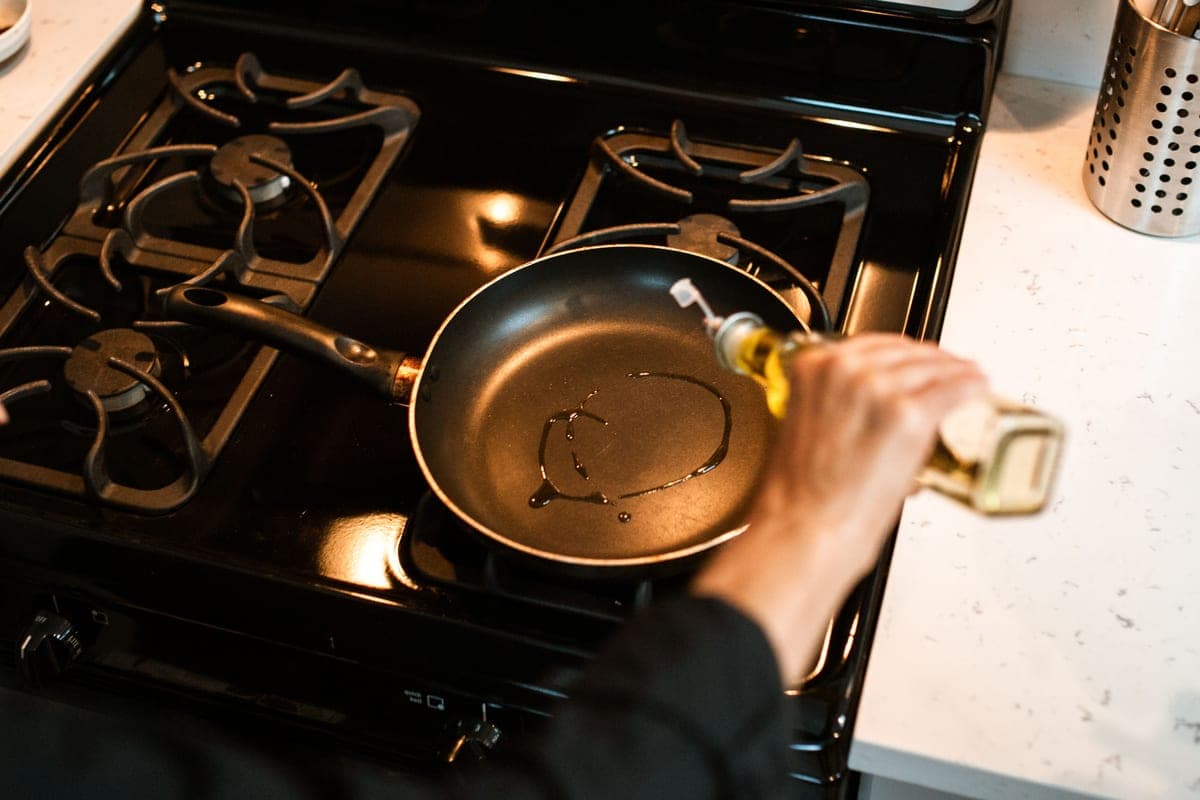
If you have gone looking for a safer pan, you have run into a wall of near-identical acronyms: PTFE, PFA, FEP, ETFE, PFOA, PFAS. They look like typos of each other. They are not. Three of them are different plastics that can all be present in the same non-stick pan at the same time, one of them was never a coating at all, and one is the umbrella category the rest sit under.
Sorting them out is worth twenty minutes because the confusion is doing real work in the market. "PFOA-free" is printed on nearly every non-stick pan sold in the US, and it is true, and it has meant very little since 2015. Meanwhile the thing most shoppers are actually asking about — whether the coating itself belongs to the PFAS family — has a clear answer that almost no packaging gives.
This page is the decoder. It is not a scare piece and it is not a defense of the industry; we have no position to protect. The aim is that by the end you can read a cookware listing, know which claims are meaningful, and know which single behavior actually matters more than the acronym on the box.
The acronyms, decoded
Two things to hold on to before the table. The published heat ratings put the first four resins in order: a Chemours licensed industrial applicator lists maximum use temperatures of about 550F for PTFE — which it calls the highest operating temperature of any fluoropolymer — 500F for PFA, 400F for FEP and 300F for ETFE. Those are coating-industry figures for the resins, not cooking instructions for a finished pan, and the pan's own manufacturer rating is always the one to follow.
And nothing in the table says that one of these is the safe one. They are variations on the same chemistry, chosen by coaters for adhesion, thickness and heat tolerance. A pan advertised as PFA-coated is not a meaningfully different purchase from a pan advertised as PTFE-coated.
| Acronym | Full name | What it is | Where you meet it |
|---|---|---|---|
| PTFE | Polytetrafluoroethylene | The original non-stick fluoropolymer. Applied as a primer-and-topcoat system | The release surface of almost every conventional non-stick pan |
| PFA | Perfluoroalkoxy alkane | A melt-processible fluoropolymer that flows during baking into a non-porous film. Rated higher than FEP for continuous heat | Mid-coats and topcoats in multi-layer cookware coatings; industrial linings |
| FEP | Fluorinated ethylene propylene | Another melt-processible fluoropolymer, lower temperature rating than PTFE or PFA | Adhesion layers and primers in multi-coat systems |
| ETFE | Ethylene tetrafluoroethylene | A copolymer that is not fully fluorinated; tougher, lowest heat rating of the four | Thick-build industrial coatings, rarely the cooking surface |
| PFOA | Perfluorooctanoic acid | Not a coating. A processing aid once used to make PTFE, and a persistent pollutant in its own right | Nothing made in the US since 2015. Still on every box as a claim |
| PFAS | Per- and polyfluoroalkyl substances | The umbrella category, defined by chemical structure rather than by use | Everything in the rows above, by the current international definition |
Is PTFE a PFAS? Yes, structurally — and that is not the whole sentence
This is the question behind most of the searches that land here, and it deserves a straight answer rather than a hedge. In 2021 the OECD published a revised definition that is now the common international reference: PFAS are fluorinated substances containing at least one fully fluorinated methyl or methylene carbon atom, which in practice means that any chemical with a perfluorinated methyl group (-CF3) or a perfluorinated methylene group (-CF2-) is a PFAS. PTFE's entire backbone is repeating -CF2- units. Read against that definition, PTFE is a PFAS, and so are PFA and FEP.
What that does and does not tell you is where the care is needed. The PFAS category defined this way is enormous and chemically varied — it covers small, mobile, water-soluble acids like PFOA and PFOS, and it covers solid polymers with molecular weights in the millions that do not dissolve, do not evaporate and are not absorbed. Those two ends of the category behave nothing alike in a body or in a river. Industry argues that fluoropolymers meet the OECD's separate criteria for polymers of low concern; critics argue that the manufacture and disposal of fluoropolymers generates exactly the small mobile PFAS that everyone agrees are a problem. Both of those arguments can be true at once, and both are, which is why regulators keep treating the category as one thing for reporting and as several things for risk.
So the useful formulation is this. If your question is "does this pan contain a PFAS?", the answer for any conventional non-stick pan is yes. If your question is "is a fluoropolymer the same risk as PFOA in drinking water?", the answer is no, and anyone telling you otherwise is skipping a very large step. Our what is PFAS page covers the category end to end.
Why one pan contains three different fluoropolymers
A non-stick pan is usually not one coating. The standard industrial build is three layers sprayed and baked in sequence: a primer that grips the roughened metal, a mid-coat that carries the durability, and a topcoat that does the actual food release. The layers use different resins because they have different jobs — PTFE alone does not bond well to aluminum, so adhesion layers are typically PTFE blended with a melt-processible resin like FEP or PFA, which flows during baking into a continuous, non-porous film.
That is the honest answer to the common search "FEP and PFA in cookware." You are unlikely ever to buy a pan sold as an FEP pan. You are very likely to own one where FEP or PFA is in the stack underneath the surface you cook on. Some manufacturers advertise two-coat or three-coat systems as a durability selling point, which is the one place the layer count is printed on the box.
The practical consequence is small but real: when a non-stick pan starts to look patchy or chalky, you are usually seeing the topcoat go and the mid-coat show through, not bare metal. That is the point at which the pan is no longer doing the job you bought it for. We set out the replacement test in when to replace a non-stick pan.
What "PFOA-free" actually means now
PFOA was never the coating. It was a processing aid used to make PTFE dispersions, and it is one of the small, mobile, persistent PFAS that the health concern is genuinely about. It does not belong in the same sentence as the finished polymer, and the marketing has thoroughly blurred that line.
The timeline is public. The EPA ran a 2010/2015 PFOA Stewardship Program under which it asked eight major manufacturers — Arkema, Asahi, BASF, Clariant, Daikin, 3M/Dyneon, DuPont and Solvay Solexis — to commit to cutting PFOA from facility emissions and product content by 95 percent no later than 2010, and to work toward eliminating it no later than 2015. All eight submitted commitments by March 2006, and all of them state they met the goals.
Which means "PFOA-free" on a pan sold in the US today is the equivalent of "contains no leaded gasoline." It is accurate. It describes an industry-wide change that happened more than a decade ago. It distinguishes the product from nothing currently on the shelf, and it is not a statement about PFAS, because the coating itself still is one. A brand making a stronger claim would have to say what replaced it — which is why genuinely coating-free categories like stainless steel and cast iron are easier to evaluate than coated ones.
The one behavior that matters more than the acronym
Heat. A fluoropolymer coating is stable across normal cooking and begins to break down when a pan is run dry and hot; Science News, reviewing decades of work on the question, puts meaningful breakdown above roughly 500F. An empty pan on a high burner reaches that in a couple of minutes, which is faster than most people assume and is the entire mechanism behind the flu-like symptoms sometimes reported after a scorched pan.
The effect is not subtle in one specific household. Birds have respiratory systems that make them acutely vulnerable to the fumes from an overheated fluoropolymer surface, and the veterinary literature on PTFE toxicosis in pet birds is unambiguous. If there is a bird in the house, this stops being a nuanced trade-off and becomes a rule — see why PTFE is dangerous for birds and pets.
For everyone else the rule set is short and dull: never preheat a coated pan empty, keep it off the broiler and the high-heat sear, use wood or silicone, and replace it when the surface goes. None of that requires knowing which of the three acronyms is in which layer.
How to use this when you are shopping
Five rules, in the order that saves you the most time. If they push you toward getting the coating out of the kitchen altogether, the two pages to read next are best non-toxic frying pans for the pan you use daily and safest cookware materials for how the whole field actually ranks by job.
- Treat "PFOA-free" as background noise. True of everything on the shelf, and not a statement about PFAS.
- Treat "PFAS-free" as a claim to check. It is a meaningful claim, and only coatings with no fluoropolymer in any layer can make it. Look for what the surface actually is — sol-gel ceramic, enamel, bare metal — rather than for the absence word.
- Do not read PFA or FEP as an upgrade. They are siblings of PTFE chosen for adhesion and heat tolerance, not safer alternatives to it.
- Ask how long the surface lasts, not just what it is. Every coating is a consumable. A pan that needs replacing every two years is a recurring decision, which is the real argument for an uncoated pan.
- Match the pan to the heat. Buy a coated pan for eggs and fish at medium heat, and something uncoated for searing. That one split removes most of the risk in this entire topic.
How we chose, and what we did not do
Every product on this page was checked against its published material composition and its third-party certifications, with each claim labeled as certified, manufacturer-stated or independently tested by a named party. We do not run a lab and we do not claim to have used these products — the full method is here.
Questions people actually ask
Is PTFE a PFAS?
By the current international definition, yes. The OECD's 2021 revision defines PFAS as fluorinated substances containing at least one fully fluorinated methyl or methylene carbon, and PTFE's backbone is repeating -CF2- units. What that does not tell you is risk: PTFE is a high-molecular-weight solid polymer, chemically very different in behavior from the small mobile PFAS like PFOA that the drinking-water concern is about.
What is PFA in cookware?
PFA is perfluoroalkoxy alkane, a melt-processible fluoropolymer in the same family as PTFE. It melts and flows during baking into a non-porous film, and a coatings applicator lists its maximum continuous use temperature at about 500F. In cookware it generally appears inside a multi-layer coating system rather than as the advertised surface.
What is FEP in cookware?
FEP is fluorinated ethylene propylene, another melt-processible fluoropolymer, rated lower for heat than PTFE or PFA at about 400F. Its usual job in a pan is adhesion: PTFE does not bond well to aluminum by itself, so primers are typically PTFE blended with FEP or PFA. You will rarely see a pan sold as an FEP pan, but many pans contain it under the cooking surface.
Is PFOA-free the same as PFAS-free?
No, and this is the most common confusion in the category. PFOA was a processing aid, phased out of US production under an EPA program that targeted elimination by 2015, so every pan sold here is PFOA-free. The fluoropolymer coating itself is still a PFAS under the current structural definition. PFAS-free is a much stronger claim and only applies to coatings with no fluoropolymer in any layer.
What is the difference between PTFE and Teflon?
Teflon is a brand, PTFE is a chemical. The brand covers a family of coating resins including PTFE, PFA, FEP and ETFE, so a pan labeled with the brand name does not tell you which resin is in which layer. A pan can also be PTFE-coated without carrying the brand at all, which is now the common case.
If my non-stick pan is scratched, is the coating in my food?
Some of it, yes — that is what a missing patch means. The particles are inert polymer rather than the mobile PFAS that regulators act on, and the FDA describes migration from an intact coating as negligible, but a scratched pan has stopped doing its job and is shedding the thing you paid for. Replace it. Our guide on when to replace a non-stick pan covers the specific signs.
Sources
- Food Packaging Forum — OECD report reconciles PFAS terminology (summary of OECD, 9 June 2021) — Quotes the revised OECD definition: any chemical with at least a perfluorinated methyl (-CF3) or methylene (-CF2-) group is a PFAS
- US FDA — Authorized Uses of PFAS in Food Contact Applications
- US FDA — PFAS used as grease-proofing agents in food packaging are no longer sold in the US — February 2024 update confirming the completed phase-out
- US FDA — 35 food contact notifications related to PFAS are no longer effective
- US EPA — Fact Sheet: 2010/2015 PFOA Stewardship Program — Eight manufacturers committed to a 95% cut in PFOA emissions and product content by 2010 and elimination by 2015
- US EPA — Our Current Understanding of the Human Health and Environmental Risks of PFAS — Regulator overview of PFAS persistence and health endpoints
- Plas-Tech Coatings (a Chemours Licensed Industrial Applicator) — what the Teflon coating resins are — Industry applicator definitions and published maximum use temperatures for PTFE (550F), PFA (500F), FEP (400F) and ETFE (300F)
- Science News — Sticky situation: nonstick surfaces can turn toxic at high heat
- PTFE toxicosis in pet birds (review, NIH PubMed Central)
Read next
Kitchen & Cookware
What PFAS actually means in cookware
PFAS, PFOA and PTFE separated with sources, plus what the labels can and cannot promise.
Kitchen & Cookware
Is Teflon safe to cook with?
What the evidence actually says about PTFE: normal use, overheating, scratched pans, and birds.
Kitchen & Cookware
When to replace a non-stick pan
Five signals a coated pan is finished, why heat ends most of them, and three replacements with no service life.
Kitchen & Cookware
Best non-toxic nonstick pans, without a fluoropolymer
PTFE-free nonstick pans compared on heat rating, disclosure and realistic coating life.
Kitchen & Cookware
The safest cookware materials, in one table
The flagship comparison table: every cookware material on PFAS status, heat limit, leaching concern and lifespan.
Written by Selena H., owner of Glass & Cotton.