Kitchen & Cookware
Xtrema vs Caraway
Both are sold as ceramic cookware. Only one of them is made of ceramic, and that single structural fact decides almost everything else.
Last reviewed November 3, 2026 — Selena H.

This is the most consequential mix-up in the whole non-toxic cookware category, and it is caused by one word being used for two unrelated things. Xtrema is ceramic: the pan is a fired ceramic body all the way through, with a glaze on it and no metal anywhere. Caraway is ceramic-coated: an aluminum pan with a thin mineral layer applied to the cooking surface. Those are not two versions of the same product. They are a pot and a paint job.
The confusion is not the brands' fault, exactly — "ceramic cookware" became the retail name for the coated category because the coating chemistry is nominally ceramic, and the handful of companies making solid ceramic pans were too small to defend the term. But the consequence lands on the buyer, because the two products have different lifespans, different failure modes, different cooking behavior and different questions worth asking.
We have reviewed each brand on its own: Xtrema and Caraway. This page is the head-to-head, and it is organized around the thing that actually decides it — not which one is safer, because on everything either company publishes neither is a problem, but which one still exists in five years.
Quick picks
| # | Product | Best for | Material | Price |
|---|---|---|---|---|
| 1 | Xtrema Versa SkilletA pan made of ceramic rather than coated with it, so there is no layer with a service life. | The fewest variables in the category | 100% ceramic through-body (no metal core | |
| 2 | 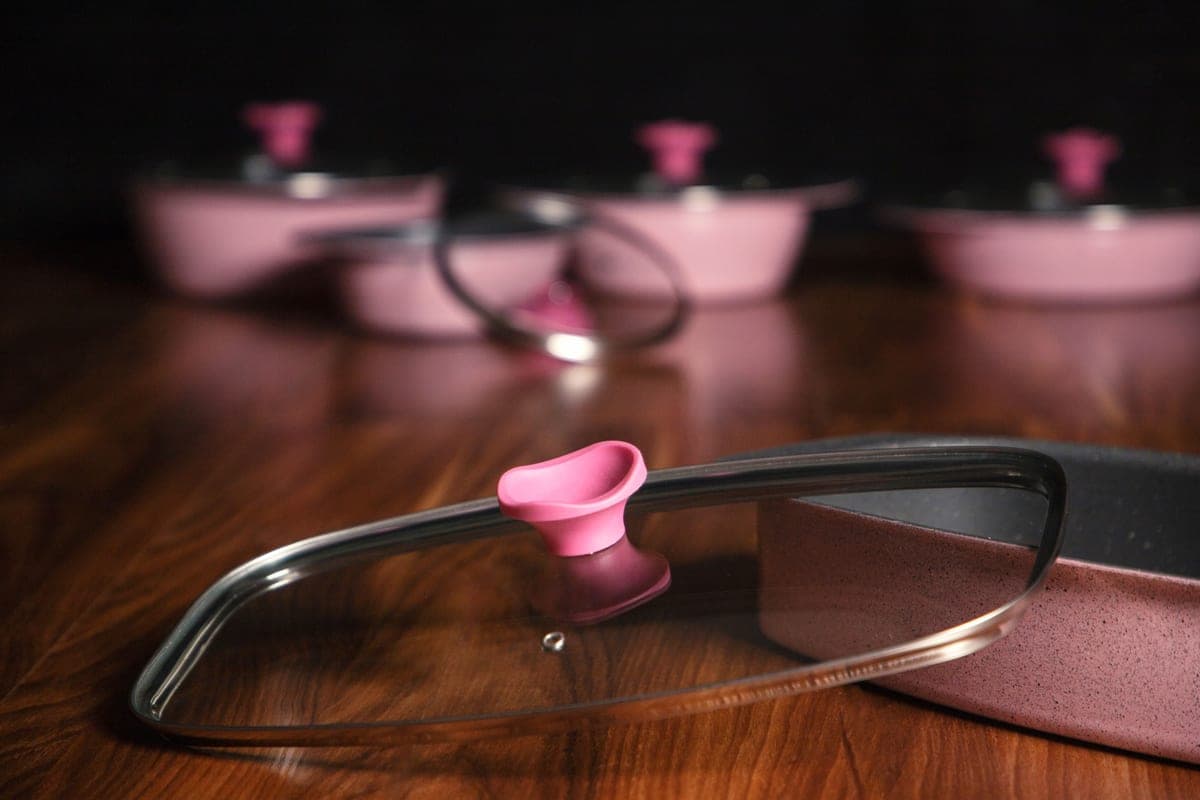 Caraway Cookware SetAn aluminum set with a ceramic coating that performs very well when new and is a consumable by design. | Release, for as long as it lasts | Aluminum body |
Tap a row to jump to that write-up. Prices are not shown on this site because they change — the button sends you to the live Amazon listing.
The structural difference, in one paragraph
Xtrema's own FAQ states that the cookware "is made of clay, water, natural minerals and oxides" and that it is "100% ceramic and does not have a metal core." There is no applied non-stick layer, no aluminum body and no stainless base plate. The cooking surface is the pan.
Caraway's cookware is an aluminum pan with what the company calls a proprietary ceramic coating on it. The coating is the cooking surface; the aluminum is the structure underneath. The company publishes that the coating is "thoughtfully made without PTFE, PFOA, and PFAS" and describes it as "made from inorganic ingredients that are FDA approved." It does not publish the composition.
Everything downstream follows from that. A coating is an applied layer with a service life; a fired ceramic body is not. A coated pan that loses its coating is a scratched aluminum pan; a ceramic pan that chips is a broken ceramic pan. One fails gradually and invisibly, the other fails suddenly and obviously. If you only take one thing from this page, take that.
Side by side
The row that decides most purchases is the second-to-last one, and it is the one neither company puts on the front page. Nothing in the table above says the Caraway coating is hazardous — on what the company publishes, it is not. It says the coating is a consumable, which is a different criticism and a more useful one.
| Xtrema | Caraway | |
|---|---|---|
| What the pan is | Fired ceramic body, glazed, no metal core | Aluminum body with an applied ceramic coating |
| Published composition | "clay, water, natural minerals and oxides" | "inorganic ingredients that are FDA approved" — no formula given |
| PFAS position | No coating exists, so the question does not arise | States the coating is made without PTFE, PFOA and PFAS |
| Published testing | States it tests every shipment for extractable lead and cadmium under California Prop 65 | States 600+ PFAS types and total organic fluorine tested with zero detected within reporting limits, and 20+ heavy metals tested |
| Named lab or method | Not published — Prop 65 is named as the standard | Not published on the pages we read — "third-party accredited laboratories" |
| Origin | States handcrafted in China | Not published; names BSCI and SMETA partners |
| Induction | No, unless you buy a separate induction disk | Yes, stainless base plate |
| Service life of the cooking surface | Indefinite — there is no layer to lose | Finite — a sol-gel coating loses release over roughly one to three years of regular use |
| How it dies | A chip or a crack, usually from a drop or thermal shock | The coating stops releasing |
| Price bracket | Premium per piece | Mid-market, sold mostly as sets |
Two kinds of testing, and why people think they disagree
If you search either brand you will find arguments about lab results that appear to contradict each other. They usually do not contradict each other at all; they are measuring two different things, and knowing which is which makes the whole argument readable.
Leach testing asks what comes out of a surface into food. The FDA's approach to lead in ceramicware is exactly this: a 24-hour acetic acid soak, with enforced limits on what migrates into the acid. California's Prop 65 framework for lead and cadmium works the same way, on migration rather than presence. When Xtrema says it tests every shipment for *extractable* lead and cadmium, that is a leach test. When Caraway says heavy metals came back "all clear," that is also a migration-style result.
Total-content testing asks what is in the material at all, whether or not any of it moves. Handheld XRF screening, which independent testers use because it is fast and non-destructive, reports total content. A glaze or a pigment can contain a metal that never migrates into food in measurable amounts, and XRF will report the metal while a leach test reports nothing.
Both measurements are legitimate and they answer different questions. For "will this get into my dinner," leach testing is the right instrument and it is the one regulators use. For "is this metal present in the object at all," total content is the right instrument. A buyer who wants a pan with no lead or cadmium *present* and a buyer who wants a pan from which none *migrates* are asking different things, and no single number answers both. We go through the same distinction for plates in best lead-free dinnerware.
What neither brand publishes is the primary document — the named lab, the method, the analytes and the numbers. Both state favorable conclusions; neither puts the report in front of you on the pages we read. That is the normal state of this category rather than a mark against either company specifically, and it is why every cookware entry on this site carries a manufacturer-claim label rather than a certification label.
Lifespan is the real decision
A sol-gel ceramic coating is thin, and its release properties degrade with heat cycling, abrasion and time. Owners of every brand in the coated category — Caraway included, and this is not a Caraway-specific flaw — report the same arc: superb release for the first months, gradual stickiness, and a pan that needs oil for the things it used to do dry. Roughly one to three years of regular use is the range people describe, and it is not a defect claim; it is what the chemistry does.
So a Caraway set is a recurring purchase at an interval you cannot schedule. That changes the arithmetic on a mid-market set considerably, and it is the single most important thing to understand before you buy into the coated category at any price. The full version of this argument, across every brand that sells one, is in best non-toxic non-stick pans.
Xtrema has no such clock. There is no layer to lose, so the pan cooks identically in year ten. What it has instead is a brittleness risk: ceramic breaks. Drop it, knock it against a sink, or thermally shock it by putting a hot pan under cold water, and it can crack or chip — and a chipped ceramic pan is finished, in the same way and for the same reason a chipped enameled pot is. The failure is sudden and total rather than gradual, and it is avoidable in a way coating wear is not.
Put plainly: the Caraway will almost certainly stop performing, and you cannot do much about when. The Xtrema will almost certainly keep performing, unless you break it, and whether you break it is largely up to you.
Cooking with each one
They are not interchangeable in the kitchen either, and the gap is wider than the marketing suggests. Caraway releases food. That is its entire proposition and it does it well when new — eggs, fish, pancakes, the things that bond to bare metal. It heats quickly because aluminum does, it is light, it is induction-compatible on the stainless base plate, and it is the pan most people reach for on a weekday morning.
Xtrema is not non-stick, despite the category name, and buyers are consistently surprised by this. Solid ceramic is slow to heat, slow to respond and slow to cool, and the brand's own guidance is conservative about dry heat — the FAQ advises never heating a dry skillet on medium or high, and recommends low settings for skillet cooking and low-to-medium for saucepans. That is a pan for braises, stews, rice, oven-to-table dishes and anything you want to cook gently. It is not a stir-fry pan and it is not an egg pan.
Induction is the hard split. Caraway works on induction; Xtrema does not, because there is no ferromagnetic material in it, and the brand's own answer is that you would need a separate induction disk sitting between the pan and the burner. If your cooktop is induction, that is close to decisive — see best non-toxic cookware for induction for what else works.
And neither is the pan for high-heat searing or stir-frying. Coated pans are mismatched to it on temperature and solid ceramic is mismatched to it on responsiveness; for that job the answer is bare metal, which is the whole argument of our best non-toxic woks roundup.
Where each brand's marketing gets ahead of its disclosure
None of that makes either company dishonest. It makes both of them normal, in a category where the published standard is low enough that short, specific sentences stand out — which is exactly what we train readers to look for in greenwashing red flags.
- "100% non-toxic" (Xtrema) is a marketing phrase with no legal definition, and it sits above a composition statement that is genuinely short and genuinely good. The statement is the useful part; the slogan adds nothing and invites the argument.
- "Made without PTFE, PFOA, and PFAS" (Caraway) is a statement about what is absent, repeated often, standing in for a statement about what is present. "Inorganic ingredients that are FDA approved" is not a composition.
- "Third-party tested" on both sides is a conclusion without a document. Neither brand puts the lab name, the method and the numbers on the page.
- Handcrafted (Xtrema) is a production description, not a materials one, and the brand is straightforward that the cookware is handcrafted in China.
- Origin is simply absent from Caraway's materials page; naming BSCI and SMETA audit schemes is a labor-standards statement, not a location.
Which to buy
Buy the Xtrema if you want the fewest variables available in cookware and you cook slowly. No coating, no metal, no replacement cycle, and a composition statement you can read in one line. Accept that it will not release an egg, will not suit induction without a disk, and will end its life in one piece on the floor rather than in a landfill of worn-out pans.
Buy the Caraway if release is the thing you actually want and you are honest with yourself about the clock. On what the company publishes, there is nothing alarming in the coating; you are buying convenience on a timer, and the question is whether the price divided by the years you get is one you would pay again. If it is, that is a perfectly rational purchase.
Buy neither if the plan was one set to cover everything. The kitchen that works is usually a bare-metal pan for heat, an enameled pot for acid, and at most one coated pan for eggs — which is the structure we lay out in lower-tox kitchen starter swaps. If you want the coated slot filled by something other than Caraway, Caraway vs GreenPan takes that comparison on directly.
The picks in full
1. Best for The fewest variables in the category
Xtrema Versa Skillet
A pan made of ceramic rather than coated with it, so there is no layer with a service life.
- Made of
- 100% ceramic through-body (no metal core, no surface coating)
- Certified to
- Manufacturer claimManufacturer claim; no third-party certification published.
- Construction
- Solid ceramic, not a coated metal pan
- Oven and broiler
- Manufacturer states oven, broiler and grill safe
- Induction
- No
Xtrema publishes a composition in one line — "clay, water, natural minerals and oxides" — and states the cookware is 100% ceramic with no metal core. It also states that every shipment is tested for extractable lead and cadmium under California Prop 65. Nothing is applied to the cooking surface, so the coating questions that dominate this category simply do not apply.
What you give up
It is not non-stick, it is slow to heat and slow to respond, it needs a separate disk to work on induction at all, and it breaks if dropped or thermally shocked. The brand's own guidance warns against heating a dry skillet on medium or high heat.
Who it's for
Braises, rice, oven-to-table cooking, and anyone avoiding metal cookware for a specific reason.
Who should skip it
Induction cooktops, fast cooking, eggs, and households that drop things.
2. Best for Release, for as long as it lasts
Caraway Cookware Set
An aluminum set with a ceramic coating that performs very well when new and is a consumable by design.
- Made of
- Aluminum body, sol-gel mineral ceramic coating, stainless steel handles and base plate
- Certified to
- Manufacturer claimManufacturer claim; no third-party certification published.
- Oven safe
- Manufacturer states 550F
- Coating type
- Ceramic (sol-gel), no PTFE
- Induction
- Yes, stainless base plate
Caraway states the coating is "thoughtfully made without PTFE, PFOA, and PFAS" and publishes testing claims covering 600+ PFAS types with zero detected within reporting limits and 20+ heavy metals tested. It heats fast, works on induction, is light to handle, and does the one thing uncoated cookware cannot: it releases food with no fat and no technique.
What you give up
The coating is a consumable — sol-gel ceramic loses release over roughly one to three years of regular use, and no brand in this category has solved that. The composition is not published, the origin is not published, and the testing is stated as a conclusion rather than shown as a report.
Who it's for
Eggs, fish, pancakes, induction kitchens, and anyone who wants a set that matches.
Who should skip it
High-heat searing, buy-it-for-life kitchens, and anyone who would resent replacing a set.
How we chose, and what we did not do
Every product on this page was checked against its published material composition and its third-party certifications, with each claim labeled as certified, manufacturer-stated or independently tested by a named party. We do not run a lab and we do not claim to have used these products — the full method is here.
Questions people actually ask
Is Xtrema the same kind of ceramic as Caraway?
No, and this is the central confusion. Xtrema is a fired ceramic body with no metal in it — the brand states the cookware is made of clay, water, natural minerals and oxides and has no metal core. Caraway is an aluminum pan with a ceramic coating applied to the cooking surface. The word is the same; the products are structurally unrelated.
Which one lasts longer?
Xtrema, by a wide margin, as long as you do not break it. There is no coating to wear out, so the cooking surface performs the same in year ten as on day one. Caraway's coating is a consumable: sol-gel ceramic loses its release properties over roughly one to three years of regular use, which is true of every brand in the coated category rather than a Caraway-specific fault.
Does Caraway really contain no PFAS?
The company states the coating is made without PTFE, PFOA and PFAS, and publishes that 600+ PFAS types and total organic fluorine were tested with zero detected within reporting limits. "Within reporting limits" is doing real work in that sentence — it means nothing was found at the sensitivity the lab used, which is the correct way to report a non-detect and is not the same claim as absolute absence.
Is Xtrema lead free?
Xtrema states that it tests every shipment for extractable lead and cadmium in accordance with California Prop 65 and that it has passed those leaching standards for 15 years. That is a statement about migration — what comes out of the glaze into food — which is the measurement the FDA and California both regulate. It is not the same measurement as total content, which is what handheld XRF screening reports, and the two can honestly give different-sounding answers about the same pan.
Can I use either one on an induction cooktop?
Caraway yes, Xtrema effectively no. Caraway's cookware has a stainless base plate that couples with the induction field. Xtrema is ceramic throughout with nothing ferromagnetic in it; the brand's own answer is that you would need a separate induction disk placed on the burner under the pan, which adds thickness, cost and a layer of lag.
Which is better value?
It depends entirely on how long you keep cookware. Caraway is cheaper per piece up front and sold as matching sets, but the coating sets a replacement interval you do not control. Xtrema costs more per piece and has no replacement interval at all. Over ten years the arithmetic usually favors Xtrema; over two years it favors Caraway, and over two years you also get a pan that releases eggs.
Sources
- Xtrema — Frequently Asked Questions (manufacturer) — 'Xtrema cookware is made of clay, water, natural minerals and oxides'; '100% ceramic and does not have a metal core'; tests 'every shipment for extractable lead and cadmium in accordance with California Prop 65'; 'cookware is handcrafted in China'; induction only with a separate disk
- Xtrema (manufacturer)
- Caraway — homepage testing and materials claims (manufacturer) — 'Our proprietary ceramic coating is thoughtfully made without PTFE, PFOA, and PFAS'; '600+ types of PFAS and Total Organic Flourine tested - zero detected within reporting limits'; '20+ heavy metals tested, including lead and cadmium - all clear'
- Caraway — Our Materials (manufacturer) — 'Our proprietary ceramic coating is made from inorganic ingredients that are FDA approved'; no composition, origin or heat limit published; names BSCI and SMETA manufacturing partners
- Caraway Home (manufacturer)
- US FDA — compliance policy guidance on lead in ceramicware (ASTM C738 leach test)
- US FDA — Food Packaging & Other Substances that Come in Contact with Food: Information for Consumers — How food contact substances are authorized, and what migration review covers
- Food Packaging Forum — OECD report reconciles PFAS terminology (summary of OECD, 9 June 2021) — Quotes the revised OECD definition: any chemical with at least a perfluorinated methyl (-CF3) or methylene (-CF2-) group is a PFAS
Read next
Kitchen & Cookware
Xtrema cookware review: the fewest variables in the category
Xtrema's solid-ceramic construction, what it genuinely eliminates, and the four practical limits.
Kitchen & Cookware
Caraway cookware review: what it is made of, and what it is certified to
Caraway's published composition, its third-party testing claim, and the coating lifespan the box does not mention.
Kitchen & Cookware
Is ceramic cookware safe?
What a sol-gel ceramic coating is, how it fails, and the one-to-three-year lifespan nobody publishes.
Kitchen & Cookware
Best ceramic cookware sets, and the distinction brands blur
Ceramic sets compared, with the coated-versus-solid distinction made explicit and the real lifespan stated.
Kitchen & Cookware
Caraway vs GreenPan: disclosure or heat tolerance?
Caraway versus GreenPan on coating, heat rating and track record — and which difference actually matters.
Written by Selena H., owner of Glass & Cotton.